Customers find out first
The site is down for forty minutes until somebody writes to support.
I add checks and alerts — your systems do the telling.
I build and improve bots and Mini Apps. I set up monitoring, Linux servers and automated application releases. I am Dmitry Savichev. Work directly with me, from reviewing the task to launch and source code handover.
Work directly with me, remotely and under a contract. Scope, timing and cost agreed before starting.

Dmitry Savichev
SRE/DevOps engineer
Your task
The site is down for forty minutes until somebody writes to support.
I add checks and alerts — your systems do the telling.
Take enquiries, connect services or display data inside Telegram.
I build a bot or Mini App around an agreed workflow.
A contractor set it up two years ago. Now everyone is afraid to touch it.
A written review of what you have and a plan for what to fix first.
Services
The work
Write-ups of my own projects: the task, the work and how the result was verified.
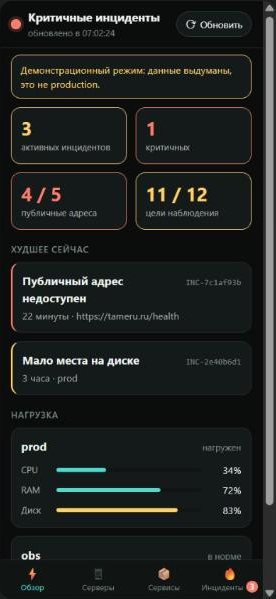
Server state and incidents open with a button in the chat.
Running in production since 31 August
Write-up
Journals had grown to 4 GB and kept going.
4.0 GB → 31 MB, no restarts
Write-up
The observation host lost connectivity and declared five healthy sites down.
A write-up of my own mistake
Write-up
Work ends with a report: what I found, what I did, how I verified it and what is left. Here is an example.
Tell me what you want to build or what is not working. No specification is needed for your first message.